

A Tesla heat pump heats the cabin in winter and cools the battery when needed, using the same refrigerant circuit as the summer air conditioning. The Model Y has one, and so do the Model 3, Model S and Model X from the 2021 model year. That is why a small leak or a faulty valve can mean a cold cabin in January, not just a hot one in July. When the climate system misbehaves, the fix starts with diagnostics, not with topping up refrigerant by guesswork.
Below we explain how Tesla air conditioning and the heat pump work together, which models have one, what is normal, which faults are common, and why Tesla refrigerant service differs from an ordinary car’s.
Which Teslas have a heat pump
The Model Y was the first to get a Tesla heat pump when it launched in 2020. The Model 3 got one with the 2021 model year update that started in late 2020, and the Model S and Model X with their 2021 update. Older Model S and X cars and early Model 3s heat the cabin with an electric heater, and their A/C is a conventional cooler. When buying used, check the car’s equipment data or have it diagnosed, as the change came mid-production.
The Tesla heat pump is built around an eight-port valve that Tesla calls the Octovalve and a so-called super manifold that puts into one block the valves and passages other cars spread around the vehicle. The design is compact and efficient, but finding a fault means reading the car’s sensors and alerts, not just measuring pressure at the service ports.
Which noises and effects are normal
According to Tesla’s manual, the compressor and the external fan may run and make noise even in cold weather when the car is heating the cabin or Supercharging. Tesla air conditioning also cools the battery, so in hot weather the compressor can run even with the A/C switched off. A car with a heat pump may release odourless steam from the front while fast charging in the cold. All of this is normal, as described in the Tesla Model 3 owner’s manual.
It is not normal if cold air comes from the vents with the heating on, an alert says the climate system is limited, you hear metallic knocking or whistling from the front, the windscreen will not demist, or there is water on the floor. The cabin should not smell musty either. If an alert appears, photograph it: the exact wording helps diagnostics find the fault faster. Have them checked before a small fault becomes a big repair.

Common faults when Tesla air conditioning will not cool or heat
Most often the cause is one of the following:
- Refrigerant leak. In a car with a heat pump, a low refrigerant charge affects both cooling and heating. Leaks can come from fittings, seals and front heat exchangers damaged by stones or a collision.
- Valve or sensor fault. The heat pump routes refrigerant with electronic expansion valves and monitors pressure and temperature with sensors. If one of them gives a wrong reading, the system switches to a protective mode and heating weakens.
- Compressor failure. The high-voltage compressor is one of the most expensive parts of the system. If it stops, both cooling and heat pump heating are lost and the car shows a climate system alert.
- Cabin blower noise. The blower motor can start to whistle or rattle, often because of leaves drawn into the air intake or a worn bearing.
- Clogged cabin filter and odour. Tesla recommends replacing the filter every two years on the Model 3 and Model Y, and every three years for HEPA and carbon filters. For the full intervals, see Tesla maintenance schedule: what to service and when.
Tesla heat pump in hard frost: what the 2022 recall showed
In winter 2021–2022, owners in Canada and the US reported heat pumps that stopped heating in severe cold. Tesla filed recall report 22V-050 with the US road safety agency: with certain firmware versions an electronic expansion valve could open unintentionally and trap refrigerant in the evaporator. The compressor then stopped as a safeguard and cabin heating was lost, particularly at –10 °C or colder. The recall covered almost 26,700 cars in the US and was fixed with an over-the-air update.
The lesson is simple: when a Tesla heat pump heats the cabin, heating depends on the refrigerant circuit, the valves and the software at the same time. If heating disappears in frost, first check for software updates and on-screen alerts. If that does not help, you need diagnostics that read sensors and fault codes. For this we use licensed Tesla diagnostic equipment, Toolbox 3. For more on winter driving, read Tesla battery in winter: preconditioning, charging and range.
Tesla air conditioning needs a different refrigerant service
Heat pump Teslas use R1234yf refrigerant and the oil specified for their electric compressor. According to the service manual for a Model 3 with a heat pump, a routine that opens the system valves must be run in the car’s service mode before refrigerant recovery, and a heat pump commissioning routine after charging. Without them, the A/C machine cannot reach the whole circuit and the charge may end up wrong. Before charging, a vacuum and pressure test shows whether there is a leak. The service manual for the new Model Y, for example, lists roughly 1,000–1,040 grams of refrigerant recovered from the system.
Tesla recommends replacing the A/C desiccant bag every two years on 2012–2020 Model S cars, every four years on 2015–2020 Model X cars and every six years on a Model 3 without a heat pump. For heat pump cars, Tesla’s vehicle maintenance support page points to the service menu on the touchscreen for your car’s own schedule.
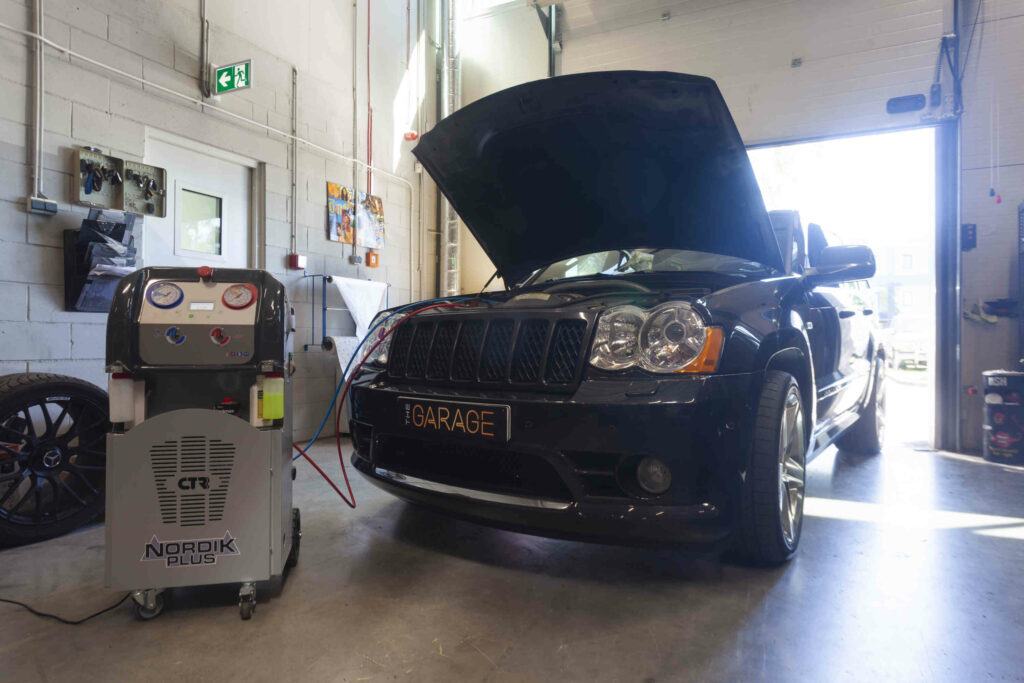
On our price list, an A/C refill starts from €250 and diagnostics and electrical work from €150, with VAT added on top. If the system leaks, we fix the leak before refilling, because refrigerant added to a leaking system escapes again.

Frequently asked questions
Why is my Tesla heat pump noisy in winter?
Tesla uses the compressor and the external fan for cabin heating and fast charging too, so hearing them in cold weather is normal. Worrying signs are metallic knocking, whistling or a noise that keeps getting louder. Then book diagnostics before the compressor or blower fails completely.
Does the Tesla heat pump work in severe frost?
Yes, the Tesla heat pump is designed for cold climates and can also draw heat from the battery. Preconditioning from the app before you leave helps, especially while plugged in. If cold air comes out in frost with the heating on and there is a climate system alert, that is a fault, not the normal effect of cold weather.
How often should the Tesla cabin filter be replaced?
Tesla recommends replacing the cabin filter every two years on the Model 3 and Model Y and every three years on the Model S. The HEPA filter is recommended every three years. If the cabin smells or the windows fog up easily, replace the filter sooner.
Can Tesla air conditioning be serviced like any other car?
Only partly. The refrigerant and the A/C machine are the same, but a Tesla with a heat pump needs service mode routines, the correct oil and fault code reading. Without them the car may cool after a refill but still heat poorly in winter.
If your Tesla heat pump is not heating, the A/C is not cooling or the cabin smells, book a visit on our Tesla maintenance page or contact us: phone +372 5851 0695, email info@servicemode.ee. The workshop is at Tähnase 1 in Peetri, about five minutes from Tallinn Airport, open Monday to Friday, 9:00 to 18:00.