

The Tesla battery warranty in Europe lasts 8 years and 160,000, 192,000 or 240,000 km depending on the model, and the battery must keep at least 70 % of its capacity during that time. It covers defects in the high-voltage battery and drive unit, not accidents, flooding or normal ageing. Once it has ended, many battery faults can still be repaired without a new pack.
Below we explain what Tesla’s terms actually say, how to check capacity, when the warranty will not help and why independent servicing does not void it. It matters to new-car owners, buyers of used Teslas from elsewhere in Europe and owners of older Model S and X cars whose warranty has run out.
Tesla battery warranty terms by model
Tesla calls it the Battery and Drive Unit Limited Warranty. It covers the high-voltage battery and the drive unit, meaning the motor with its gearbox and inverter. The period starts when Tesla delivered the car to its first owner, not when a used car was bought, and whichever limit comes first applies.
- Model S and Model X: 8 years or 240,000 km, at least 70 % capacity.
- Model 3 and Model Y base RWD: 8 years or 160,000 km, at least 70 % capacity.
- Model 3 and Model Y Long Range and Performance: 8 years or 192,000 km, at least 70 % capacity.
The current terms are on Tesla’s warranty support page. The basic vehicle warranty is 4 years or 80,000 km, so the Tesla battery warranty lasts twice as long. The Tesla app shows your car’s coverage under “Specs & Warranty” at the bottom of the home screen, on the “Warranty” tab.
What the 70 % capacity threshold means
Every lithium-ion battery loses some capacity over the years, and Tesla states plainly that normal, gradual energy loss is not covered. The Tesla battery warranty covers the case where capacity drops below 70 % of the original within the warranty period. For reference, Tesla’s own data shows Model S and X batteries losing 12 % on average after 200,000 miles, roughly 320,000 km.
Note that the Tesla battery warranty terms call the range on the screen an imperfect measure of capacity, since temperature and driving style affect it, and Tesla chooses the measurement method. Many cars show an estimate under Controls > Service > Battery Health, and a battery test of up to 24 hours is also available. Our Tesla battery health check article explains how to read the result.
What the Tesla battery warranty does not cover
The exclusions in the warranty document are specific. The battery and drive unit warranty does not cover:
- collision or accident damage, except damage from a fire in the battery itself;
- opening or servicing the battery or drive unit by anyone other than Tesla or certified personnel;
- flooding, direct flame, and deliberate attempts to change battery life physically or through software;
- letting the battery run flat until the car cannot drive and not recharging it within two weeks;
- normal capacity loss while capacity stays above 70 %, and effects of software updates on battery performance.
The general exclusions also name environmental factors such as road salt, and driving over kerbs, potholes and other hazardous surfaces. A battery casing dented by a rock or kerb is an insurance matter, not a warranty case. In winter, mind the two-week rule: never leave a car parked for weeks at the airport with a nearly empty battery.
Independent servicing and your warranty
Under EU competition rules, a manufacturer’s warranty may not require that non-warranty maintenance and repairs be done only within the authorised network, or that the manufacturer’s own brand of parts be used for them, as the European Commission’s guidance explains. Tesla’s warranty likewise says not all work has to be done at Tesla, but damage from improper maintenance or repair is not covered.
So maintenance, brakes, suspension, 3D wheel alignment, glass replacement and diagnostics at an independent workshop do not affect the Tesla battery warranty, provided the work is done correctly. Tesla asks owners to keep records, so keep invoices showing the VIN, workshop name and address, mileage, date and work done. We use Tesla’s licensed Toolbox 3 diagnostic equipment and original parts.
The exception is the battery and drive unit themselves. Tesla does their warranty repairs, and damage from the battery being opened by anyone other than Tesla or certified personnel is not covered. While the Tesla battery warranty is valid, have a fault diagnosed and documented with Toolbox 3, but leave repairs to the battery itself to Tesla.
Terms for older Model S and Model X cars
Older Model S and Model X cars had different terms: 8 years with no mileage limit, except the original 60 kWh battery made before 2015, which had 8 years or 200,000 km. Those terms did not cover gradual capacity loss; the 70 % guarantee came to the S and X later. Each car keeps the terms valid when it was bought.
In practice, the Tesla battery warranty on a 2014 Model S 85 ended in 2022 at the latest, whatever the mileage. Used cars are also subject to the warranty region rule: warranty service is provided in the region where the car was first sold. A car sold in Europe is covered across the European region, while a Tesla imported from the USA belongs to a different one.
What happens after the Tesla battery warranty ends
After the warranty, the owner pays for repairs, but the choice is not only a new battery or selling the car. Many faults are local: the BMS board, contactors, a single module, a coolant leak or seals. One Model S 85 pack in our workshop showed 95 % charge on the BMS, yet we measured only about 50 V DC instead of roughly 400 V.
Road salt and time had corroded the aluminium, water had reached the BMS board section, the BMS had failed and the contactors had burned and welded shut. With a pack like that, diagnostics decide whether repair makes sense. Read more about our battery repair service.
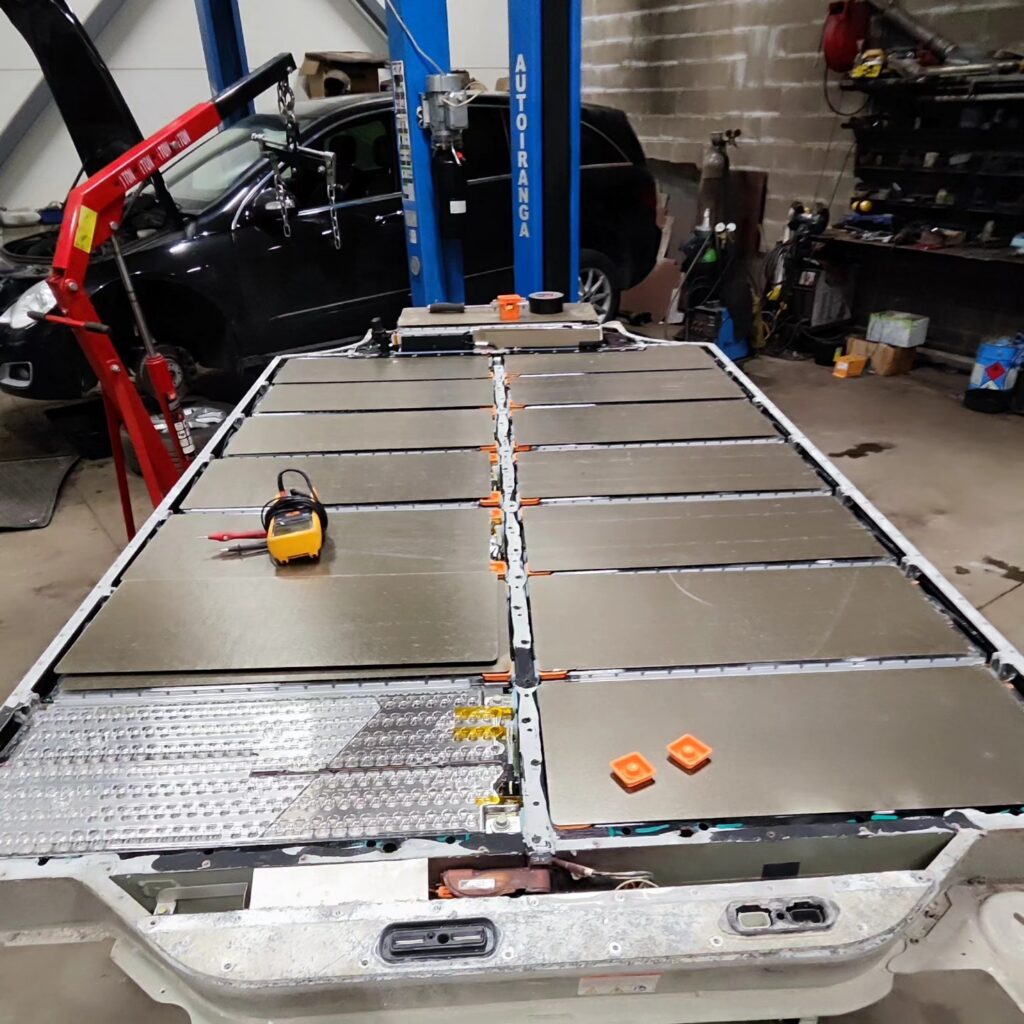
Before deciding, we measure cell group voltages and insulation resistance and look for traces of moisture. Diagnostics and electrical work start from €150, prices exclude VAT. So when the Tesla battery warranty has ended, you can decide on facts rather than fear.
Frequently asked questions
Is the Tesla battery warranty valid on a used car?
Yes. The Tesla battery warranty transfers to the new owner free of charge, but its period runs from the car’s first delivery. Before buying, check the remaining years and kilometres in the Tesla app and make sure the car was first sold in the European warranty region.
Does servicing at an independent workshop void the warranty?
No. EU rules and Tesla’s own terms allow servicing outside Tesla. Only damage caused by improper work, or by the battery or drive unit being opened by someone other than Tesla or certified personnel, is excluded.
What happens if capacity drops below 70 % during the warranty?
Tesla repairs the battery or replaces it with a new, reconditioned or remanufactured one. The replacement matches the car’s age and mileage and must provide at least the minimum capacity until the warranty period ends.
Does the Tesla battery warranty cover reduced range in winter?
No. A cold battery temporarily delivers less energy and charges more slowly, but that is not capacity loss. If the range does not recover in warm weather either, have the battery checked.
Not sure whether a fault is a warranty matter? Book diagnostics: we read the battery alerts with Toolbox 3 and tell you whether it is a job for Tesla or one we can fix at our workshop in Peetri, next to Tallinn. See our Tesla maintenance service, call +372 5851 0695, email info@servicemode.ee or contact us.