

Tesla suspension repair usually starts with a noise: a creak when turning at low speed, a clunk over a speed bump or a dull knock from the rear. On the Model 3 and Model Y the cause is often a front upper control arm or a rear knuckle bushing; on the Model S and Model X it is usually the air suspension. The right order is to inspect the car on a lift, replace the worn part and then align the wheels.
Estonian and Finnish roads are hard on any suspension. Winter brings road salt and slush into the joints, spring brings potholes. An electric car is heavier than a petrol car of the same size, and low-profile tyres on large wheels absorb less. Take even a small new noise seriously: Tesla suspension repair is cheaper when play is found before the worn part has ruined a tyre.
Five signs your suspension is worn
The noise and when it appears often point to the fault before the car is on a lift. These are the five most common signs we see in Tesla suspension repair and their likely cause:
- Creaking from the front when steering at low speed or crossing a speed bump: the front upper control arm ball joints.
- A clunk or knock from the rear on a bumpy road: the upper rear knuckle bushings.
- A dull click over small bumps on both sides: the anti-roll bar end links.
- A crunch when braking or accelerating: the rubber bushings of the front lower arms.
- One corner sits lower after standing (Model S and Model X): an air suspension leak.
Tyre wear tells a story too: if the inner edge wears noticeably faster than the outer edge, worn bushings or a poor alignment have put the wheel angles off. We check every joint one by one on a test drive and on the lift, because a loose underbody panel or bolt can sound similar.
Model 3 and Model Y: front upper control arms
The best-known issue is creaking front upper control arms. Tesla describes it in service bulletin SB-20-31-006: on some 2018-2020 Model 3, Model Y and Model X vehicles, water can get into the upper control arm ball joints and cause surface corrosion. The result is a creak from the front suspension when the wheel is turned at low speed under load.
Tesla’s fix was to seal the area around the ball joints with urethane, and the bulletin calls it a noise issue that does not make the joint fail early. The real condition shows on the lift. If the dust boot is intact and there is no play, resealing may be enough. If the joint already has play, the arm is replaced, because the ball joint is part of it. Check both sides at the same time.
Rear knuckle bushings
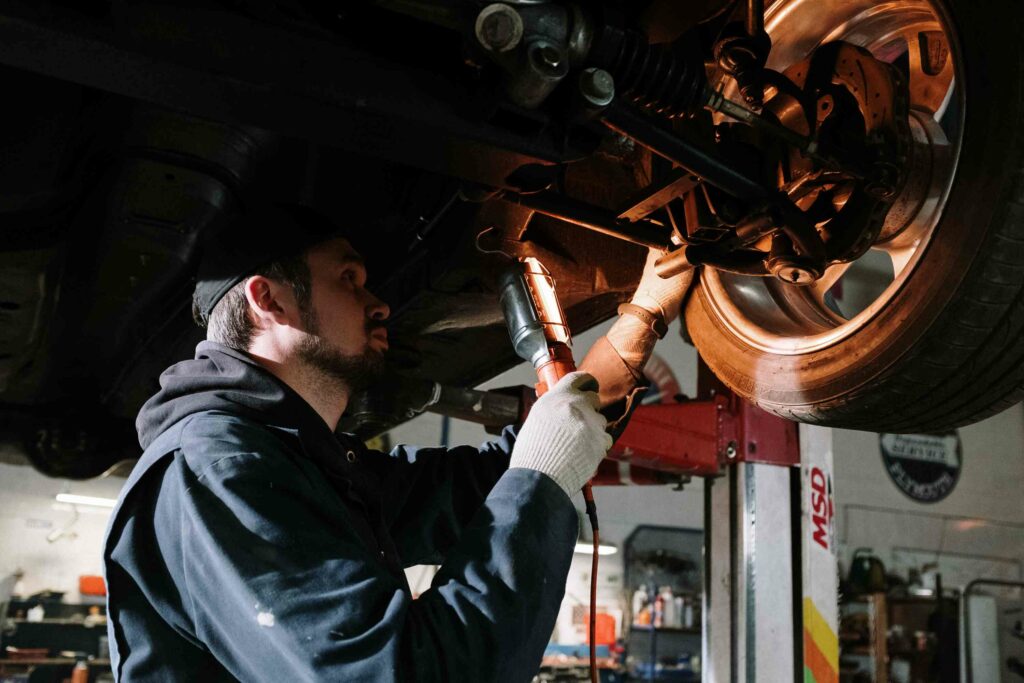
The rear knuckles of the Model 3 and Model Y have bushings at the top with a ball socket inside. Over time the socket wears and play develops. The signs are a knock or creak from the rear and faster wear on the inner tyre edge, because a loose bushing lets the top of the wheel lean inwards. You can feel the play with the wheel off the ground, the suspension loaded and the tyre rocked top and bottom.
This is a Tesla suspension repair we have done ourselves on a Model 3 rear axle. Afterwards the rear geometry has to be measured and set again, otherwise the uneven tyre wear continues even with new parts. If the bushings are worn on both sides, replace them in pairs so the car behaves the same way in left and right corners.
Model S and Model X: air suspension
The larger models are different: the Model X and most Model S cars have air suspension. Each corner has an air strut, a compressor supplies the air, a valve block distributes it and height sensors keep watch. The typical fault is a slow leak at a strut, an air line or the valve block. The car drops on one corner overnight, and the compressor runs more than usual and wears out early. In winter, moisture in the system can freeze.
Driving on a leaking air strut for long is a bad idea, because the extra work falls on the compressor. On these cars, Tesla suspension repair starts with locating the leak, and we read the air suspension alerts with Toolbox 3. If you lift an air-suspended Model S or X with a jack yourself, first turn on Jack Mode on the touchscreen. Tesla’s owner’s manual warns that the car could otherwise try to level itself.
How Tesla suspension repair works
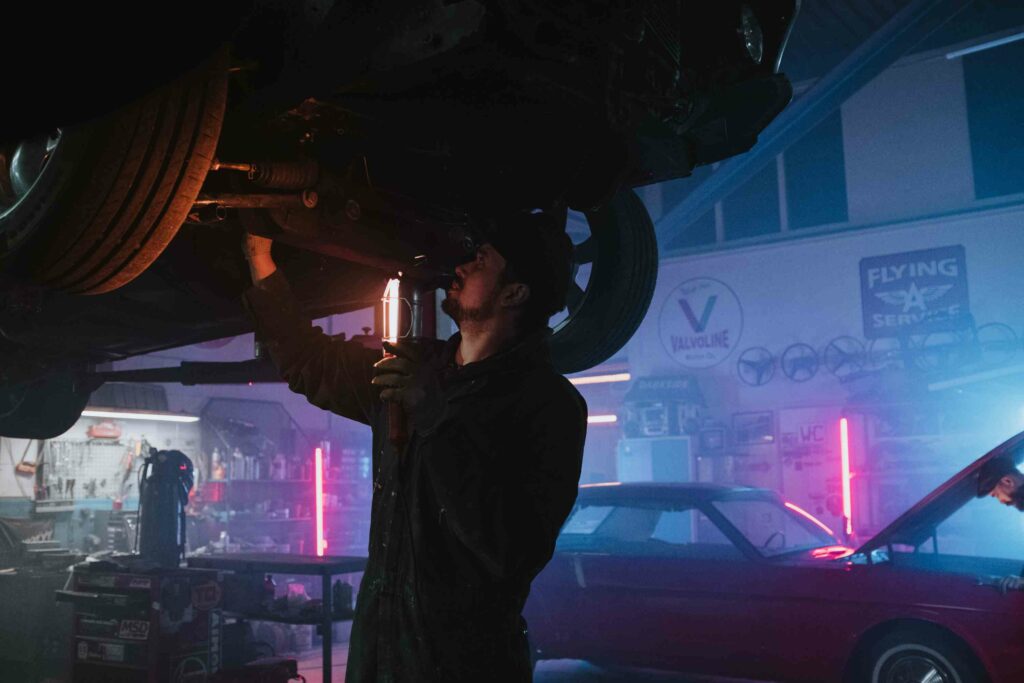
The job starts with a test drive so we hear the noise as you do. On the lift we then check ball joints and bushings for play, dust boots, dampers for leaks and the anti-roll bar links. On an air-suspended car we also check whether a corner loses pressure and which alerts the car has stored. Only then is it clear which part to replace.
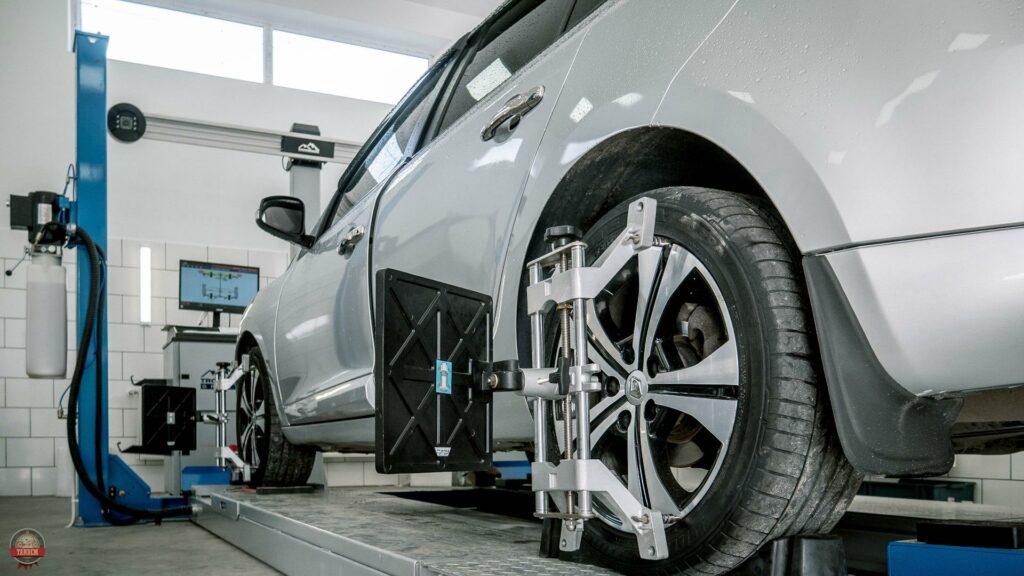
Replacing any control arm, bushing, tie rod end or damper changes the wheel position at least slightly. That is why Tesla suspension repair should end with measuring and setting the alignment. Our 3D alignment system measures all four wheels at once. Why a heavy electric car is so sensitive to wheel angles is explained in our article on Tesla wheel alignment.
We use quality parts and follow Tesla Service protocols. Before starting, we tell you what is worn and what can wait. If only one bushing is worn, there is no need to replace the whole assembly. There is more on our Tesla repair service page.
Tesla suspension repair before the inspection
The technical inspection also checks suspension joints and bushings, and too much play in a ball joint or bushing can mean a re-inspection. Have the suspension checked on a lift beforehand so there are no surprises. What else to check first is covered in our article on the Tesla technical inspection.
Frequently asked questions
Why does my Tesla creak when turning at low speed?
On the Model 3, Model Y and 2018-2020 Model X, the most likely cause is the front upper control arm ball joints after water has got into them. Anti-roll bar bushings can make the same noise. An inspection on a lift shows the exact cause, because every joint can be checked separately.
Is it safe to drive a Tesla with a knocking suspension?
For a short while usually yes, but a knock means a joint or bushing is moving more than it should. The play grows, the tyres wear unevenly and in the worst case the handling changes. If the noise started after a hard pothole hit, do not put off Tesla suspension repair and have the car checked straight away.
Do I need an alignment after Tesla suspension repair?
Yes, if control arms, bushings, tie rod ends or dampers were replaced. Even fitting an original part changes the wheel angles slightly, and the result only shows on measurement. Without an alignment, a new tyre can wear out as fast as the old one.
How much does Tesla suspension repair cost?
Tesla repair work starts from €80, 3D wheel alignment from €100, and diagnostics and fault code reading from €150. Prices exclude VAT. The final cost depends on whether one bushing or a whole control arm needs replacing, and it is clear after the inspection.
If your Tesla knocks, creaks or sits low on one corner, book a visit to our workshop at Tähnase 1, Peetri, about five minutes from Tallinn airport. Call +372 5851 0695 or email info@servicemode.ee. We check the car on a lift, tell you honestly what is worn and set the wheel angles after the repair.