

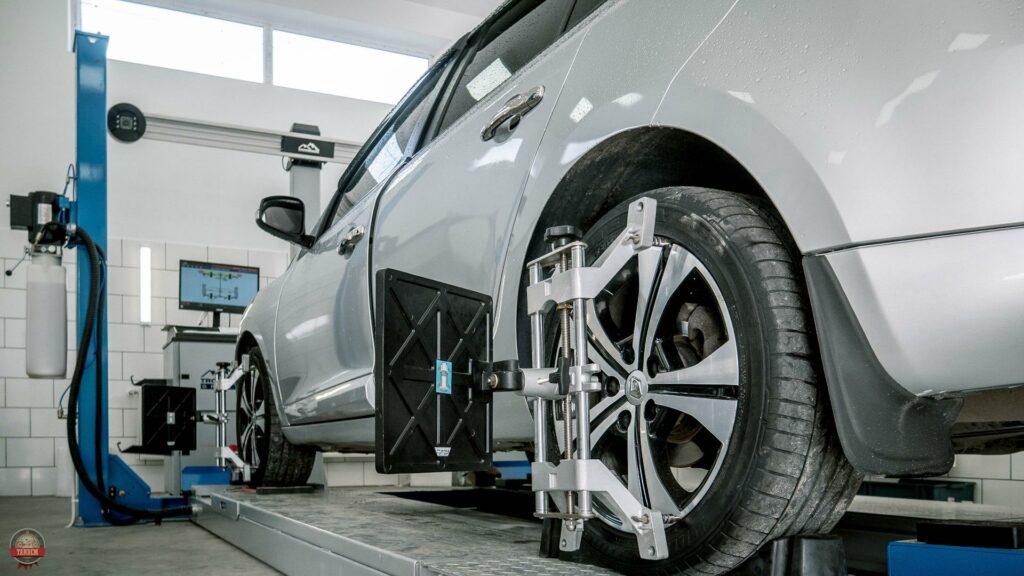
A Tesla wheel alignment on a 3D rig means measuring and adjusting the wheel angles so that the tyres roll straight and wear evenly. On a Tesla this matters more than usual: the car is heavy, the factory camber is negative, and the instant torque of the electric motor loads the tyres. If the inner edge of a tyre wears faster than the outer edge, the car pulls to one side or the steering wheel is off centre when driving straight, it is time to have the angles measured.
Below we explain why Teslas wear the inner edges of their tyres, when a Tesla wheel alignment is needed, what you can check yourself and what Tesla’s service manual prescribes.
Why Tesla tyres wear on the inner edge
A Model Y weighs close to two tonnes, and the Model S and Model X even more. The battery’s weight loads the suspension bushings and arms, which give way over time, and the wheel angles change with them. In the German TÜV report for 2026, the main defects on the Tesla Model Y were in the axle suspension, the brake discs and the lighting. As the ADAC summary explains, EV suspension suffers under the heavy traction battery.
The second reason is geometry. According to the factory figures for the new Model 3, front camber is about –0.5 and rear camber about –1 degree, so the inner part of the tyre carries more load even in a straight line. If incorrect toe is added, for example after hitting a pothole, the inner edge wears quickly. Hidden behind the wheel, the damage often goes unnoticed until the cords show.
5 situations that call for a Tesla wheel alignment
Tesla’s owner’s manual advises having the wheels aligned if a tyre wears unevenly on one side or the car pulls while the steering wheel is held straight. The Model Y manual also recommends an alignment after fitting a new set of tyres. In practice, book a Tesla wheel alignment in these situations:
- New tyres. A new set is expensive, and with the wrong angles its inner edge can wear out in the first season.
- Uneven wear. The inner edge is lower than the other grooves, or the tread shows feathered edges that are sharp in one direction.
- The car pulls or the steering wheel is off centre. If the car drifts on a straight, level road or the wheel is not centred when driving straight, the angles are out.
- A hard impact. Spring potholes and kerbs can bend a suspension arm or shift the adjustment.
- Suspension repair. After replacing arms, bushings, tie rods or shock absorbers, the wheels must always be realigned. Read more in Tesla suspension repair: knocks, bushings and air suspension.
If the steering wheel vibrates, the cause is more likely wheel balance than alignment. Tesla’s manual recommends wheel balancing in that case, because unbalanced wheels affect handling and shorten tyre life.
How 3D wheel alignment measures a Tesla
A target is clamped to each wheel, and cameras read their position as the car is rolled slightly forward and back. The software calculates camber, toe and caster for each wheel, plus the car’s thrust angle, and compares them with the factory specifications. 3D wheel alignment shows the readings before and after adjustment.
Tesla’s service manual sets conditions for the measurement: tyre pressures must match the door pillar label, ride height must be within limits and the suspension must be in good order. On the Model 3 and Model Y, a total of 68 kg of ballast is placed on the driver and front passenger seats so that the angles match real driving. The full procedure is in the Tesla Model 3 service manual.
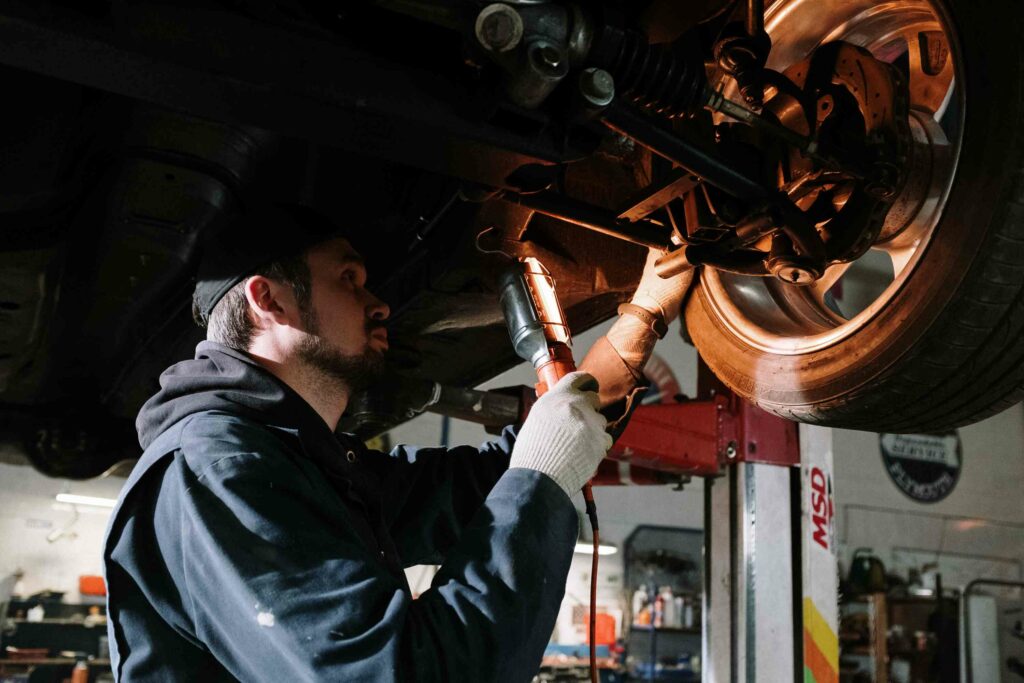
Front toe is adjusted at the tie rods, while rear toe and camber are adjusted at the rear links. On the newer Model 3, front camber and caster can be changed at the upper control arm mounting. After adjustment, the service manual requires a routine in the car’s service mode that clears the stored offset, and this needs a Tesla diagnostic tool. We use licensed Toolbox 3.
On a Tesla it is not enough to set only the front toe, because the rear wheel angles are adjustable too. If the rear axle is out and the front wheels are set straight relative to it, the car crabs slightly and the steering wheel stays off centre. 3D wheel alignment measures all four wheels at once and sets the rear wheels first, then the front, so that the direction of travel and the steering wheel line up.
What you can check yourself
When you change tyres, look at the inner and outer edges and the centre of each tyre. A cheap gauge will measure tread depth, and if an edge is clearly lower than the centre, that points to an alignment fault or wrong tyre pressure. Tesla recommends rotating the tyres every 10,000 km or when the tread depth difference reaches 1.5 mm. The guidance is in the Tesla Model 3 owner’s manual.
While driving, check whether the steering wheel is centred on a straight road and whether the car holds its line when you briefly relax your grip. Check tyre pressures cold, because pressure drops in frost and a soft tyre wears on its edges. If a sign keeps coming back, a Tesla wheel alignment costs less than a new set of tyres.
Tesla wheel alignment price and what it includes
On our price list, 3D wheel alignment starts from €100, with VAT added on top. It includes measurement, adjustment and comparison with the factory specifications. If the measurement shows that a bushing, tie rod end or arm is worn, it must be replaced before alignment, because no setting will hold on a suspension full of play.
It makes most sense to combine a Tesla wheel alignment with the seasonal tyre change or with fitting new tyres. If your technical inspection is coming up, also read Tesla technical inspection: common defects and how to prepare, since the inspection checks suspension play too.
Frequently asked questions
How often is a Tesla wheel alignment needed?
Tesla’s maintenance schedule has no fixed alignment interval; it is done as needed. If you drive a lot on rough roads, it is sensible to have the angles checked once a year at the tyre change. It must be done after new tyres, a hard impact and suspension repairs.
Does poor alignment affect a Tesla’s range?
Slightly, yes. When the wheels do not roll quite straight, the tyres scrub the road and rolling resistance rises, which means a little more energy use. The bigger cost is the tyres: with the wrong angles, the inner edge wears much faster than the rest of the tread and the tyre has to be replaced early. That costs more than the lost range.
Is a Tesla wheel alignment needed after every tyre change?
No. If you swap complete wheels between seasons, the suspension geometry does not change. For a new set of tyres Tesla does recommend an alignment, so the first season of the new tyres is not wasted by wrong angles.
Can a Model S or Model X with air suspension be aligned?
Yes, but the car must be at the correct ride height during measurement and the suspension must be in good order. A leaking air spring or wrong height gives a false result, so suspension faults must be fixed before alignment.
If your Tesla’s tyres wear unevenly, the car pulls to one side or you have fitted new tyres, book a Tesla wheel alignment on our 3D wheel alignment page or contact us: phone +372 5851 0695, email info@servicemode.ee. The workshop is at Tähnase 1 in Peetri, about five minutes from Tallinn Airport, open Monday to Friday, 9:00 to 18:00.