

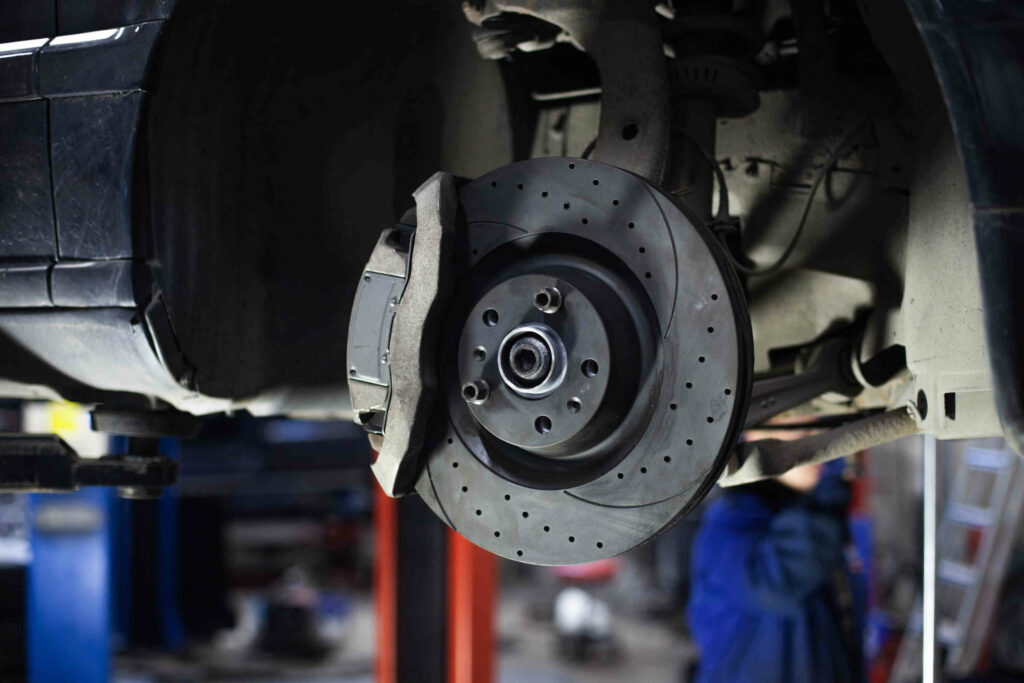
Tesla brakes wear far less than those on a conventional car, because regenerative braking does most of the slowing down. In an Estonian or Finnish winter that is their weak spot: the pads last, but road salt rusts the discs and seizes the caliper slide pins. The fix is cheaper than new discs: have the calipers cleaned and lubricated once a year, as Tesla recommends for cars driven on salted roads.
Below we explain why Tesla brakes fail despite light use, which noises and warnings signal a problem, when to replace pads and discs, and what to do if the parking brake will not release.
Why Tesla brakes rust even though they are rarely used
When you lift off the accelerator, the motor slows the car and feeds energy back into the battery. The hydraulic brakes join in only under firmer braking. Tesla’s manual states that the pads are therefore used less and that rust and corrosion can build up, especially on salted roads. Newer Model Y cars have a brake disc wiping feature that lightly touches the discs in wet weather, but it does not keep salt away.
With a cold or fully charged battery, regenerative braking is limited and the car adds friction braking automatically, so deceleration feels the same. That is good for safety, but not enough to keep the discs clean. When a car sits for days in salty slush, the discs rust and the caliper’s moving parts start to stick. For other cold-weather issues, see Tesla in winter: doors, windows, tyres and salt.
The problem shows up in inspection statistics too. In the German TÜV report for 2026, the Tesla Model Y had the highest defect rate among two- to three-year-old cars, 17.3 per cent, mostly in the axle suspension, brake discs and lighting. As the ADAC summary explains, EV brakes are rarely used because of regeneration.
Tesla brakes need yearly service on salted roads
Tesla recommends cleaning and lubricating the brake calipers every year or 20,000 km if the car is driven where roads are salted in winter. Estonia and Finland clearly qualify. Tesla also recommends a brake fluid health check every four years, with replacement if necessary. The caliper recommendation is in the Tesla Model Y owner’s manual.
During a caliper service the wheels and pads come off, and the pad abutments and caliper brackets are cleaned of rust. The slide pins are cleaned and greased with brake lubricant, the piston dust boots are inspected, and pad and disc thickness is measured. A good time is spring, after the salt season, or the autumn tyre change, when the wheels are off anyway.
5 signs your Tesla brakes need attention
Tesla brakes usually tell you when something is wrong. Watch for the following:
- A high-pitched squeal when braking. Tesla pads have wear indicators, a thin metal strip that squeals against the disc when the pad is worn.
- A scraping or grinding noise. Often the pad is worn to the metal or the disc carries a thick layer of rust.
- The car pulls to one side under braking. A seized slide pin or piston makes one wheel brake differently from the other.
- One wheel is hotter than the others after a drive. A pad is dragging on the disc, wasting energy and heating it up.
- A warning on the screen. A red brake symbol means a brake system fault or low brake fluid, while an amber parking brake indicator means an electrical parking brake fault.
When to replace pads and discs
Because Tesla brakes wear slowly, discs are often replaced for corrosion rather than wear. The inner face of the disc hides behind the wheel and can be badly rusted even when the outer face looks shiny. That is why Tesla calls for periodic visual inspection with the wheel removed. If a disc is below minimum thickness or deeply pitted, the discs are replaced together with the pads, always on both sides of the axle.
Light surface rust on Tesla brakes can be removed by the driver. Tesla’s guide recommends burnishing the brakes: on a straight, quiet road, drive at 80–90 km/h, brake with moderate, steady pressure down to 15 km/h, and repeat six times with at least 30 seconds in between. If the noise or vibration stays, the cause is deeper and the car needs to go on a lift.
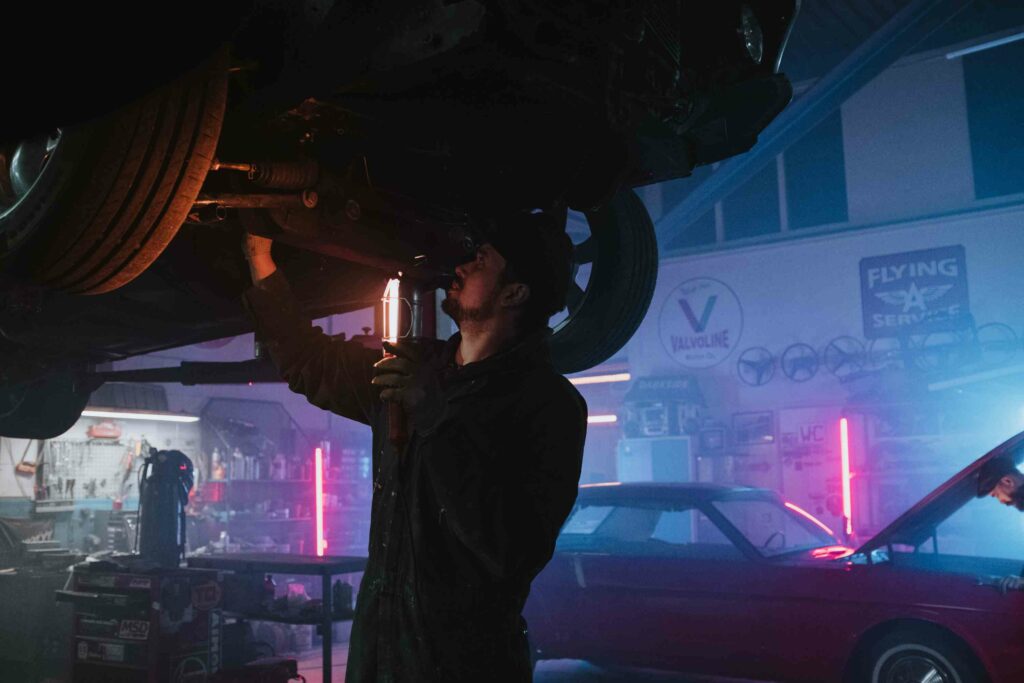
On our price list, brake pad and disc replacement starts from €80 and Tesla maintenance from €60, with VAT added on top. The final amount depends on the model and on whether the discs need replacing too. You get an exact quote once the brakes have been taken apart and measured.
Parking brake will not release: what to do
The Tesla parking brake is electric and works on the rear wheels only. If it has an electrical fault, an amber parking brake indicator lights up along with an alert. In winter the cause is often mechanical: rust or a seized mechanism. The Tesla Model S service manual has a separate procedure for a parking brake caliper that has seized or whose motor has failed.
If the parking brake will not release, do not force the car to move, as that can damage the pads and discs. Check the 12 V battery too: according to Tesla’s manual, a car without power cannot release its parking brake until it has been jump started. More on this in Tesla 12V battery: signs of a flat battery and replacement. If needed, we can arrange door-to-door transport to our workshop.
Tesla brakes at the technical inspection
At the inspection, a roller brake tester measures the braking force of each axle and the difference between left and right. Rusty discs and seized slide pins give a weak or uneven result, and the car may be sent back for a re-inspection. If an inspection is coming up, have your Tesla brakes checked a couple of weeks ahead so parts can be ordered and fitted.
Frequently asked questions
How often do Tesla brake pads need replacing?
There is no fixed mileage for Tesla brakes, because pad wear depends on driving style and on how much of the braking the motor does. Discs often rust before the pads wear out. The safest approach is to measure pads and discs at the yearly caliper service and replace them on condition, not by the calendar.
Why do Tesla brakes squeal after rain or a car wash?
Moisture leaves a thin film of rust on the disc within a few hours, and it disappears after the first few stops. If the noise continues after a few dozen kilometres, the cause is likely the wear indicator, the pad edges or deeper corrosion, and burnishing or a workshop check will help.
Does regular braking help prevent rust?
Yes, partly. Tesla’s manual advises using the brake pedal regularly or burnishing the brakes as needed to avoid rust build-up. The German TÜV association also recommends that EV drivers brake firmly from time to time. On its own this will not beat a salty winter, so the yearly caliper cleaning is still needed.
Does Tesla brake fluid need replacing?
Tesla recommends a brake fluid health check every four years, with replacement when the check shows it is needed. Brake fluid absorbs moisture over time, which lowers its boiling point and encourages corrosion inside the system.
If your Tesla brakes squeal, the car pulls to one side or the calipers have not been serviced for over a year, book a visit on our Tesla maintenance page or contact us: phone +372 5851 0695, email info@servicemode.ee. The workshop is at Tähnase 1 in Peetri, about five minutes from Tallinn Airport, open Monday to Friday, 9:00 to 18:00.